

Civil Code 1927

Tenant's Pursuit of Quiet Enjoyment

Transition Village

A Bill that would allow BART to develop its own high density housing is gaining steam in the state legislature. Assembly Bill 2923 is meant to allow BART to ignore local zoning regulations, create its own building standards and require that cities conform to BART’s development plan for any of its properties within half a mile of its stations. With the prevalent housing crisis in the Bay Are,  many see the passing of this bill as a solution to mitigate the housing shortage.

However, despite the amount of housing BART plans to create after the passage of AB 2923 there are some who object. Many cities and their represented officials disagree with the amount of freedom BART will be granted in constructing new developments. Concord Mayor Edi Birson along with other disapproving city officials went to Sacramento to get bill amended in order to give communities more say in the development process such as building aesthetics and height restrictions. Another issue regarding the BART transitional villages is the possible loss of parking lots; the building of housing in BART properties  could limit or eliminate parking lot access, making people park their vehicles on city streets.

The amended bill has passed the State Assembly and will now head over to the Senate Appropriations Committee. If AB 2923 passes BART could be setting new model for housing in the Bay Area.

Let us know what you think.

Don’t forget to follow us on Facebook!

For original article on CBS SF Bay Area News click here.

Oakland_Skyline1-550x367


Last week the Oakland City Council voted unanimously to extend Oakland’s Just Cause for Eviction Ordinance to tenants who live in owner-occupied duplexes and triplexes. The decision took place after a long 11 hour city council meeting filled with people from opposing sides expressing their opinions to the council. The deciding factor will come in November when voters decide whether or not they will approve the measure.

Some tenant advocates believe that the owners of duplexes and triplexes are taking advantage of the existing loophole which allows the owners to evict their tenants without cause, as long as the owners move into one of the units. However, the City of Oakland has admitted to not having the resources to keep track of how many owners actually end up moving in and staying for the required period of 2 years. Therefore, allowing some owners to evict tenants without just cause.

On the other side there are the owners of the duplexes and triplexes, making the argument that they are not the problem, stating that in fact the extension of the Oakland Eviction Protection Ordinance will jeopardize them economically. The inability for them to be able to raise rent on existing tenants creates troubles for many since they use that revenue as part of their income.

Please let us know what you think.

Don’t forget to follow us on Facebook!

Click here to view full article in NBC Bay Area News.

news-aleutie

This upcoming Tuesday the City Council of Oakland will be voting on a ballot measure proposed by City Council members Dan Kalb and Noelle Gallo — which may offer protection from evictions to tenants who live in owner-occupied duplexes and triplexes. Currently, tenants that live in owner-occupied duplexes and triplexes can be evicted without just cause as long as the landlord moves into one of the units for a period of time.

Many tenants rights advocates argue that the loophole is being abused by landlords (usually new investors) to get tenants out, raise rents and usher in tenants who will be able to pay for the increased cost of the unit. However, some landlords argue that they should have the right to decide who gets to live near them in their own building complex. Some housing experts argue that the problem is not landlords but rather the shortage of housing stock caused by the city’s zoning regulations which make it hard for developers to create housing in the city.

Unfortunately, the City of Oakland does not have the means to track the number of no cause evictions and no way of enforcing owner move ins. If the Oakland City Council approves the measure on Tuesday it will appear in November’s ballot for voters to have the final say.

Please comment and let us know what you think.

Follow us on Facebook!

Click here for fill article in NBC News.

download__3_

Currently, as many as you know and witness — Oakland has a large homeless population, a population that keeps growing due to the area’s housing crisis. Many Bay Area organizations such as churches are attempting to mitigate the housing crisis by offering their parking lots to house people and their vehicles (RV’s and cars); while the attempts are noble, they are merely bad-aid solutions.

Oakland City officials recognize that something needs to be done about the displacement and will be voting on a tax measure on July 24, 2018, which if passed will be placed on November’s ballot. The tax will only be applied to the 5% of landlord’s who make $200,000 or more in rental revenue a year. “we’re capturing revenue that has a relationship to the problem” says council woman Rebecca Kaplan. Oakland landlord’s currently pay 1.39% business tax of their rental revenue — adding the extra 1% is estimated to generate $7.8 million in annual funding for the city’s homeless programs. The money raised by the tax would go towards shelters, sanitation, clean up services, counseling, assistance and rehousing efforts.

Please share with us your thoughts and follow us on Facebook!

To view full article on Mercury News click here.

Ferry

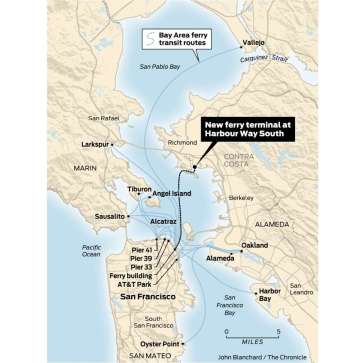
Coming this fall, Richmond’s Harbor Way South will be opening a terminal which will provide 30 minute water commutes to the city of San Francisco. Officials, developers and business owners are excited for the opening of the terminal since it will most likely trigger economic development in the area. Richmond Mayor, Tom Butt believes the opening of the terminal will be an opportunity for the city of Richmond to rid itself of stereotypes that have slowed down economic progress, “Perception is everything”.

However, while the opening of the terminal may significantly boost the city’s economy, many are hesitant about the gentrification that will accompany the economic boom. There are worries that the opening of the ferry will cause tenant displacement in one of the Eat Bay’s more affordable cities since the mode of transportation will entice people to want to move to the area. “If rents go up in certain areas around the ferry, that would cause rents to go up in other parts of Richmond,” said city’s vice mayor, Melvin Willis.

While the shoreline area in Richmond has slowly began to change with the openings of new businesses, the ferry will definitely have a more visible impact in the areas’ economic and housing development.

Please let us know what you think and don’t forget to follow us on Facebook!

Click here for full article from the SF Chronicle.

Darrin-Hodgetts-case-study-image

This past Sunday, July 1, 2018 San Francisco became the first major city to approve a $15 minimum wage increase. However, despite the increase, data suggests that this $1 increase will not even come close to mitigating the high cost of living in San Francisco. With the new $15 minimum wage people will need to work about 23 hours a day for 7 seven days to live comfortably.

According to the federal government, a family of 4 with an annual income of $117,400 living in San Francisco, San Mateo and Marin counties are now considered being low income. This figure may seem surprising but it becomes more comprehensible when one looks at the cost of housing alone.

Please follow us on Facebook and share your thoughts!

To view full article click here.

uber-lyft7

The Oakland City Council is considering two new taxes for the California November ballot; a mansion tax and an Uber/Lyft tax.

The new Uber/Lyft fee would add an additional 50 cent charge to all rides taken with Uber and Lyft. Oakland City Council officials see this tax as a way for the transportation companies to pitch in for the maintenance and repair of the roads they use, but as of now have not contributed to their upkeep. Reductions to the fee may apply for riders that partake in the more environmentally friendly, such as “pool’ rides.

The Transportation Network Companies (TNCs) would collect the new added fee through the app and remit the money to the city. The tax proposal still needs to be approved by the City Council’s Legislation Committee and the full council to be placed on November’s ballot.

To view full article on East Bay Express, click here.

Don’t forget to follow us on Facebook!

tiny-house_750xx4032-2265-0-259

The California housing crisis has given rise to the creation of many potential living solutions. This past weekend the city of San Jose hosted the Tiny Homes Festival at the Santa Clara Fairgrounds. While most of these tiny homes are less than 300 square feet, many who live in them love the idea of not having to pay expensive rents, and be able to afford a home of their own.

While many counties in California do not allow these tiny homes as acceptable dwelling units, the American Tiny House Association is working to advocate for allowing these houses to be available to the general public.

Would you live in a Tiny Home? Why? Why Not?

Please click here to view full article on ABC 7 News.

Follow us on Facebook!

san-francisco-bay-area-homes-and-housing.jpgDespite the beautiful scenery of the Bay Area, many residents have had enough with traffic and the continuing rising costs of housing. According to results of the 2017 Bay Area Council Poll, it was found that 40 percent of respondents are considering leaving the Bay Area in the next few years. More and more people are looking to move to states like Texas, Arizona, Oregon and Nevada.

Would you leave the Bay?

Click here for the full article on ABC 7 News.

Follow and Like us on Facebook!

Shipping Container

Fed up with the rising prices of homes in California?

Well, Luke Iseman an Oakland entrepreneur may have come up with a minimalist solution to the California housing crisis. Iseman has started a business (Boxhouse) turning shipping containers into small homes.

Iseman realized that what he was paying for rent in San Francisco could go to converting and owning a shipping container home. The 160 square doesn’t offer much space but it does allow for all the basic necessities.

Ideally Iseman envisions these houses in public streets, empty lots and driveways but currently there are no cities whose housing codes permit theses small metal homes. However, the shipping containers can be placed within single family homes whose backyards can contain a shipping container home or any other home.

Click here for the full article on KRON4.

Follow and Like us on Facebook!